Landauer House human rights charity concert
The Glass RoomThe Landauer House human rights charity concert brings public attention to the refugee crisis into the Glass Room: a benefit for the Human Rights League, a showcase for Miroslav Němec, and an occasion on which Viktor warns that oppression across Europe’s borders may reach the young democracy itself. Its success rests on a charged conjunction. The house attracts visitors as an architectural spectacle, the music makes the gathering a cultural event, and the appeal asks its audience to treat the suffering of others as a political concern rather than a distant one.
Purpose and Preparation
Viktor tells Liesel that he has been invited to join the Human Rights League’s committee. With refugees arriving from Germany, most of them Jews, the League’s president is seeking funds. Viktor expects the family’s business, Landauerovka, to contribute and proposes using the house for a benefit. The plan takes shape as a short recital by Němec: sixty places at a deliberately high price, a way to raise money while drawing on the public’s curiosity about the celebrated residence.
The event’s practical arrangement also makes the house part of its appeal. Tickets sell quickly, and the audience comes not only to hear a pianist but to see the Landauer House. The benefit thus depends on a tension between architecture as an object of fascination and the urgent humanitarian purpose that has brought people together. The house’s prestige helps attract an audience; Viktor’s introduction asks that audience to look beyond the house and beyond its borders.
The Concert in the Glass Room
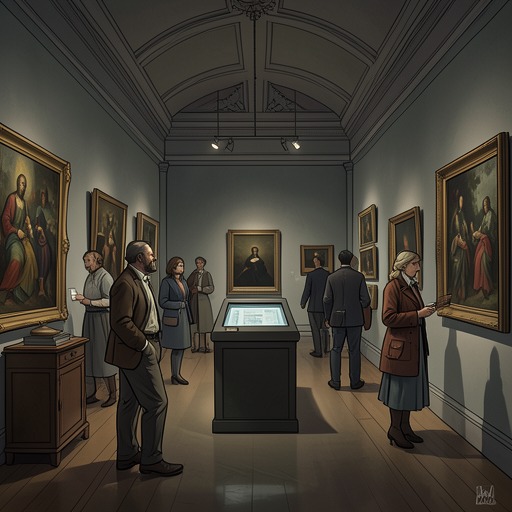
Sixty-five tickets sell within days. Chairs are arranged in arcs on either side of the onyx wall, and the piano is moved so that the room’s focus turns inward, away from the glass walls. The change reshapes the Glass Room for performance: instead of directing attention outward through its transparent boundary, the seating and instrument gather the audience around the music and the central interior.
Visitors enter with visible surprise or admiration, many as interested in the room as in the recital. Hana sits solemnly at the back, in the library area; Milada Němcová, the pianist’s wife, takes a prominent seat at the front. Before the music begins, Viktor welcomes the guests and speaks on behalf of the League. He reminds them that their young democracy must attend to what is happening to its neighbours, warning that those who are oppressed now may not be the only ones at risk if others stand aside. The concert’s charitable purpose therefore becomes an explicit appeal to political attention.
Němec descends the stairs and enters the Glass Room to applause. His programme begins with a Brahms intermezzo, continues with Janáček’s piano sonata From the Street, and concludes after an interval with a Schubert sonata. The performances display the accuracy, sensitivity, and force for which he is known. A music critic later places him among the foremost interpreters of the time, while Prager Tagblatt gives the event a notice under the title Human Rights Bring Cultural Bonus. The League chairman’s closing assessment joins the two measures of success: artistic distinction and solidarity with oppressed peoples.
Public Performance and Private Strain
The recital’s public message does not erase the private tensions among those present. Hana’s grave presence at the back contrasts with the social ceremony of the full room, and her response to Němec’s performance is notably unadmiring: she privately compares him to a vulture. The comment complicates the audience’s acclaim without changing the concert’s public reception. A performance can be celebrated as a cultural achievement while carrying different meanings for someone whose relationship with the performer is personal.
The room also makes spectatorship part of the evening’s structure. Guests come to look at the famous house, and the arrangement turns them into an audience gathered around a staged event. Later, during a separate gathering at the Glass Room, a crowd leaves Liesel feeling trapped; Hana leads her toward the terrace as a speech about the house’s place in European architecture continues. That later scene is not part of the charity concert, but it sharpens a recurring contrast: the Glass Room can be presented as an architectural ideal and a public space while also becoming oppressive when attention, ceremony, and people press in on those inside.
Later Echoes and Significance
Years later, the house is again the setting for a public encounter, but now the occasion concerns its history and possible handover. A city official brings an invitation for the family to witness the transfer, presenting the visit as part of a changed political climate and an opening to the West. Liesel’s mother recalls that the family had believed a deported woman dead: they had heard of her arrest in 1942 while they were in Cuba, then lost information amid the postwar confusion and the displacement of people trying to return home. The invitation’s language of restored relations meets a family history shaped by persecution, exile, and uncertainty.
The charity concert and the later invitation are distinct events, yet their juxtaposition gives the earlier benefit an enduring significance. At the recital, Viktor asks the audience to recognize danger to neighbours before it becomes danger at home. In the later return, public acknowledgment and architectural heritage cannot by themselves undo the losses or answer every question carried by the family. The Glass Room’s apparently ageless balance and its capacity to hold sharply different gatherings make it a fitting frame for that contrast: a place where solidarity can be publicly declared, while the consequences of history remain present and unresolved.